4-1
Safety in the mine
As cities grow and the need for mineral resources rises, mining keeps expanding, especially in developing countries. Mining is among the hardest jobs in the world and its environment is dangerous, so safety must be the organisation's first priority. Every year many people lose their lives in mining accidents, and in Iran too mine accidents cause several deaths each year.
The national technical and executive system (Cabinet resolution of 1385) stresses the use of criteria, standards and technical rules in preparing and implementing plans, and attention to maintenance and operating costs. Compared with other industries, mining carries many hazards; because accidents lead to deaths and disabilities, evaluation of health, safety and environment (HSE) in mines is very important. Its results help managers and engineers design health and safety systems for high-risk environments and prevent accidents.
4-2
What is HSE?
HSE is formed from the initials of Health, Safety, Environment — and Energy. In general, HSE covers the laws, regulations and processes for the safety of workers and contractors in the workplace, fire-fighting, protection of the environment and protection of the surroundings against hazards. A safe workplace, free of hazards and accidents, can be achieved nationwide through an HSE management system; what matters most is training staff in health and safety according to HSE standards.
History of HSE
Health, safety and environment became an issue with the Industrial Revolution, when many workers died from accidents and disease under poor working conditions and the link between disease and accidents was discovered. In 1970 a law was passed to protect workers' rights, requiring employers to explain all work hazards to their workers. In Iran, HSE dates back to 1353 (1974), when, under clause 26 of the law, the National Iranian Oil Company was required in every contract to take full care to protect natural resources and prevent pollution of air, water and land.
4-3
HSE topics
Health
Health covers monitoring the wellbeing of staff who work in polluted and hazardous environments, such as with radiation or in polluted air. Health monitoring:
- Detects adverse factors early, so the employer can control them and stop them spreading
- Provides information to assess health hazards and risks
- Makes staff more aware of possible hazards around them
- Creates an opportunity to train staff on health matters
Safety
Safety protects staff from the hazards of work operations. Some jobs, such as work at height, welding and drilling, are high-risk, and staff health is endangered if safety is not observed. Providing safety equipment, making the workplace safe and fire management are all part of safety in HSE.
Environment
The environmental function controls the negative effects of industrial activity on nature, including pollution from industrial machinery such as hydrocarbon and diesel emissions. Its aim is to reduce waste and harmful pollution and to provide services that prevent or reduce such damage.
Energy
Energy is directly linked to future generations, so the organisation's programme must include ways to use energy optimally and prevent its waste in every industry.
Technical safety & the HSE management system
In technical safety, what matters most is applying safety at the design stage: hazards must be identified and eliminated during design, which is far more economical and practical than after people or assets are harmed. The team must be able to assess hazards and risks, under the HSE management system (HSE-MS). The HSE-MS is a standard framework based on ISO 14001 and ISO 45001 that safeguards health, safety and the environment; it should run as part of the organisation's activities. Its benefits are better health and safety, higher efficiency through fewer accidents, and better relations — staff who see concern for their health feel valued, which raises productivity.
Protecting the workforce's health and preventing environmental damage during economic development require fundamental, complementary measures that raise efficiency and productivity and build a lasting safety culture in mines. Assessing safety is complex and time-consuming: at least two factors — an unsafe environment and an unsafe act — are involved in any accident, and quantifying each usually requires detailed study.
4-4
Safety in mines
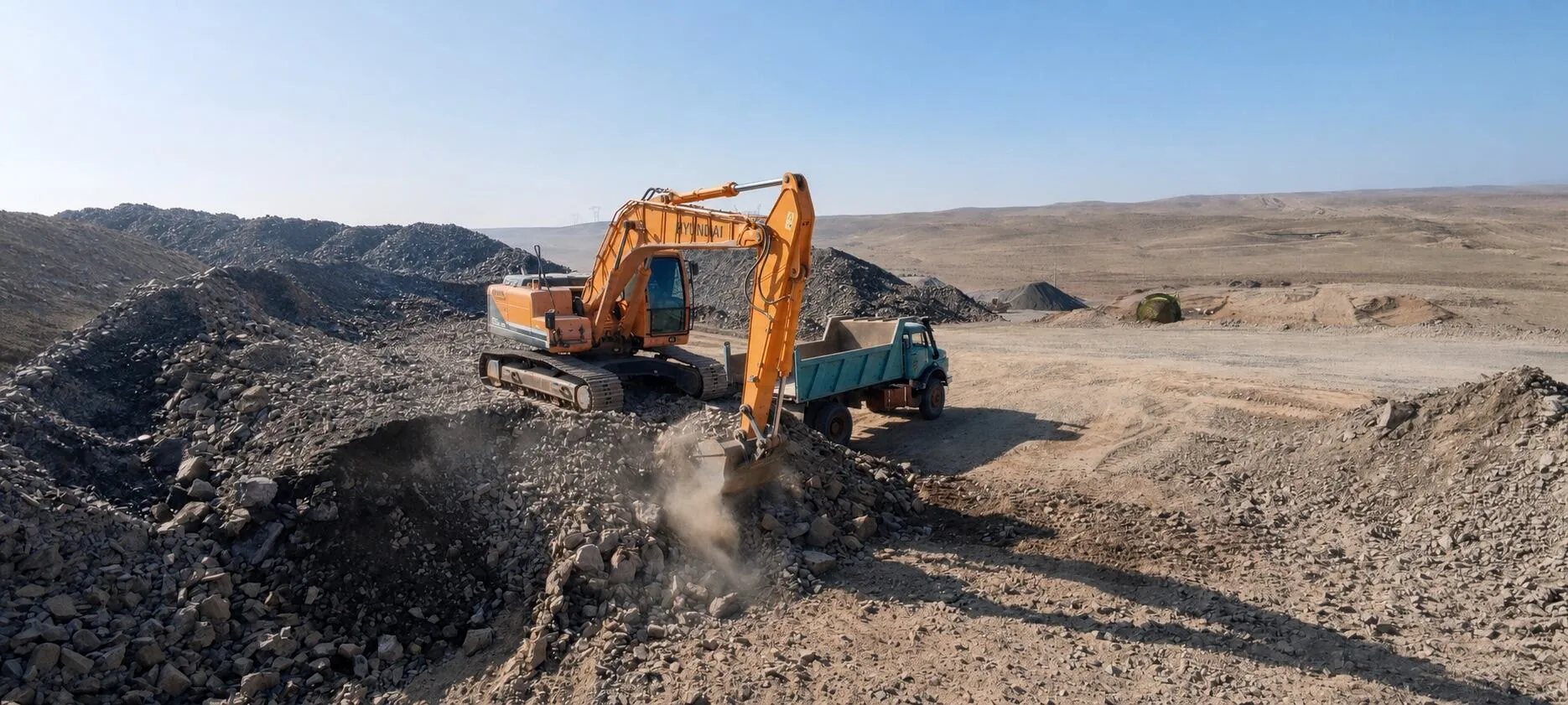
A mine is an operating area where heavy machinery works over large areas, and ignoring safety can cause accidents — in some cases fatal and irreparable. The best way to prevent them is to observe safety rules.
- A safety officer is required for every site; in small mines the technical manager takes on this role
- Before hiring, each worker attends a safety class of a few hours given by the mine's safety officer
- Workers sign a commitment to use personal protective equipment
- Pre-employment medical examinations, repeated periodically twice a year
- PPE — safety shoes, masks, gloves, helmets — is compulsory, supplied and checked by the operator; penalties are recommended for not using it
- Every machine has a dedicated driver with the proper licence
- Safety signs and banners are installed, e.g. electric-shock warnings on all electrical panels and PPE reminders
- Fire extinguishers are placed on all machinery, beside electrical panels and wherever fire is possible, and recharged periodically
- At the end of extraction the operator must make good all environmental damage to the area
4-5
Training
Supervisors and workers must stay alert throughout their shift and care for their own and their colleagues' safety. The first step is not ignoring danger: accepting that work in industry and mining is inherently hazardous and that the slightest carelessness can have irreparable consequences. When planning tasks, do not think only of finishing work and saving cost — allocate enough time and money to safety. All hazards must be assessed and removed as far as possible; where they cannot be, the team must be given clear instructions and training on how to deal with and reduce them.
All personnel — new and experienced — must attend regular mine-safety courses combining theory and practice. Managers, supervisors and workers must complete HSE training at different levels and identify and correct unsafe or unhealthy conditions; officers need training in accident analysis to find root causes. Training is an integral part of the mine's HSE policy, with minimum standards set to ensure staff know the hazards of their work and that controls are in place. The most important point is repetition: working constantly in a hazardous environment makes danger feel normal, and only repeated training keeps the risks in mind.
4-6
Electrical safety
Electrical safety is one of the most important aspects of occupational safety, since electricity can cause electric shock, fire and even explosion. Mines use many electrical devices that are moved in and out, so cables can be pulled and damaged. A properly standardised earthing well is one of the most important safeguards. Key measures:
- Staff training on electrical hazards, safe work, hazard identification and emergency action
- PPE: insulating gloves, safety shoes, helmets, anti-spark clothing and safety glasses
- Regular inspection for worn cables and loose connections, and preventive maintenance
- Keeping a safe distance from high-voltage equipment, with warning signs and guard rails
- Earthing systems installed and tested regularly
- Residual-current devices (RCDs) to cut power on leakage or short circuit
- Lockout/Tagout before repair or service
- Preventing overload with proper fuses and breakers
- Keeping water and moisture away from equipment; waterproof and spark-proof gear in wet areas
- Following standards such as NEC, IEC and local codes
- Explosion-proof equipment in areas with explosion risk
- Emergency plans and training in fire extinguishers and first aid
- Smart monitoring and automation to reduce direct human contact with electricity
- Continuous risk assessment and recording of electrical incidents
Electrical safety is not only a technical matter but a cultural one that needs the participation of all staff and management. Supervisors and safety officers should set a standard policy on how and when electrical cables are used, so miners know it and can follow it.
4-7
Explosion safety
Explosions can cause severe loss of life and property, so many measures and standards must be followed:
- Regular training on explosion hazards, safety equipment, detection of explosive gases and emergency action
- Gas monitoring with detectors, and rapid evacuation if dangerous gases rise
- Strong, efficient ventilation and a supply of fresh air
- Dust control with wetting and dust-collection systems
- Where controlled blasting is needed, low-sensitivity explosives suited to the mine, with strict protocols and safety distances
- Inspection of electrical and mechanical equipment against sparks and overheating; explosion-proof equipment in high-risk zones
- Emergency and evacuation plans with regular drills
- National and international mine-safety standards such as MSHA and ISO
- Smart sensors, robots and automatic monitoring
- Continuous risk assessment and improvement
- PPE such as helmets, respirators and anti-spark clothing
4-8
Health & wellbeing
Mine work can be physically and mentally demanding; good nutrition and rest go a long way to preventing accidents, because tired or unfit workers make more mistakes. Workers with heavy duties should be checked for health and fitness at accredited medical centres approved by the Ministry of Industry and Mines. To protect the lungs, always use suitable respiratory protection: inhaling particles or long exposure at extraction sites can damage the lungs, sometimes only after years. Mining companies should assess respiratory conditions and provide suitable respirators. Using personal safety equipment is an essential rule that can save lives in critical situations.
4-9
Personal protective equipment (PPE)
Using PPE is not only a legal requirement but a moral responsibility for the health and safety of staff; employers must ensure staff have suitable equipment and use it correctly. PPE is a pillar of safety in high-risk industries such as construction, mining, chemicals and manufacturing.
- Protects life and health against shock, burns, cuts, chemicals and toxic gases, and can prevent fatal accidents
- As the last line of defence, reduces the severity of injuries — e.g. a helmet against falling objects
- Required by law and standards such as OSHA and ISO; non-compliance can bring fines or site closure
- Raises productivity and reduces absence and treatment costs
- Protects against unpredictable hazards such as splashes, sparks and airborne particles
- Builds a safety culture — staff follow what they see colleagues and management do
- Prevents long-term effects such as respiratory and skin diseases
- Reduces costs of treatment, compensation and stoppage, and improves the organisation's standing
- Suits special conditions — harnesses, acid-resistant clothing and breathing apparatus
- Protects the environment too, e.g. respirators preventing release of toxic gases
Common PPE
- Helmet — protects the head from impact and falling objects
- Safety glasses — protect the eyes from splashes and particles
- Safety gloves — protect hands from cuts, burns and chemicals
- Respirator — prevents inhaling dust, gases and toxic vapours
- Protective clothing — resistant to fire, chemicals and harsh weather
- Safety shoes — protect feet from falling objects and slipping
- Ear protection — reduces hearing damage in noisy areas
Using PPE correctly
- Choose PPE to match the hazards of the workplace
- Train staff in correct use and care
- Inspect regularly and replace when needed
- Make sure it is comfortable and fits, so it does not hinder work
Source: Nangerd operating-licence extension plan, chapter 4 (HSE), Bahman Infrastructure Development Group, Winter 1403.
Technical dossier →