
Nangerd Ballast MineNANGERDBahman InfrastructureDevelopment Group
Nangerd railway ballast

Tests & quality control

Tests on Nangerd ballast

Overview

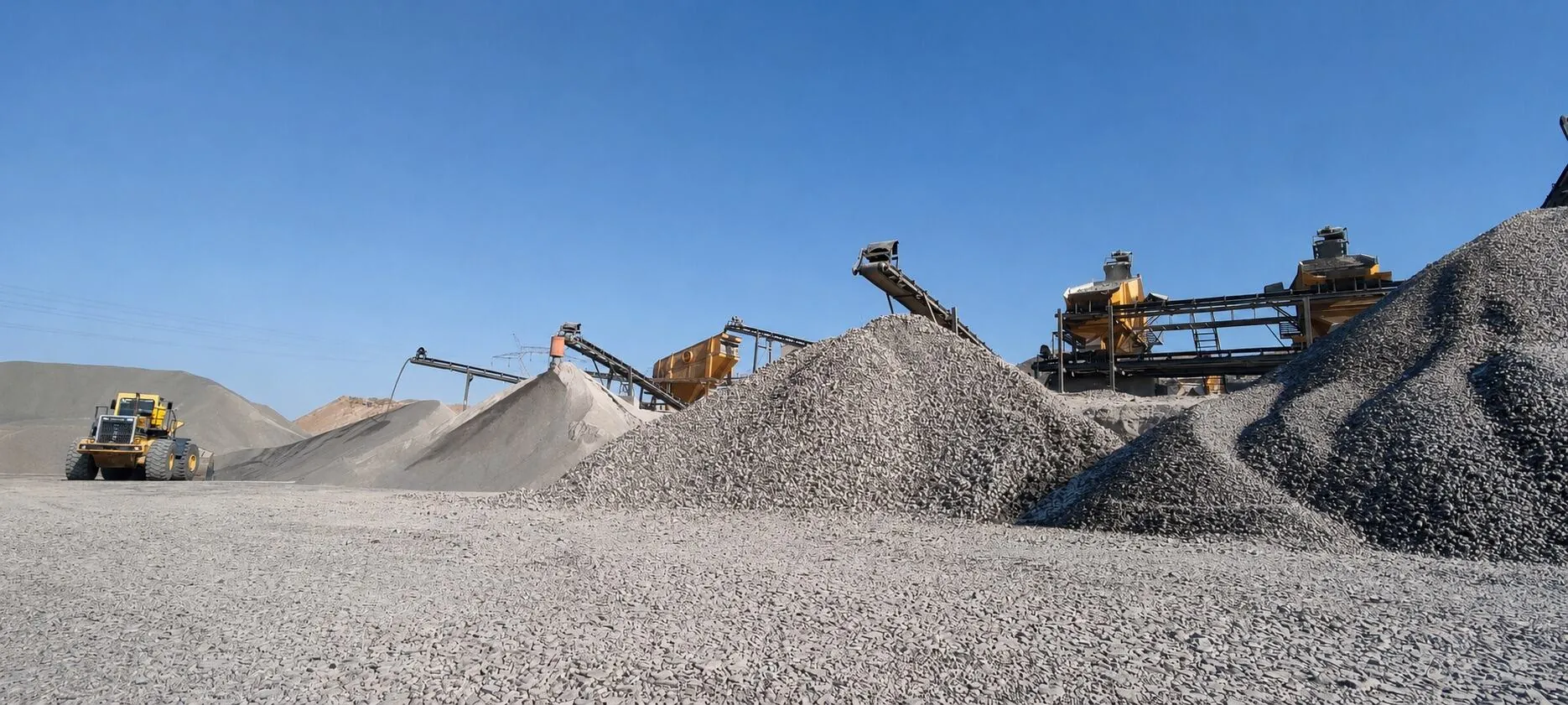
Given the type of mineral (andesite) and its compressive strength, water absorption, Los Angeles value and other properties, this stone is well suited for use as ballast. The tests below were carried out on the mine's stone and ballast by the Markazi Province Technical & Soil Mechanics Laboratory. At present the material is approved by the national railway and is the best ballast in the west of the country.

Laboratory
Markazi Province Technical & Soil Mechanics Laboratory, Arak
Subject
Quality control of coarse aggregate (ballast) from the Nangerd mine
Dates
Ballast samples received 13 Dey 1401; results issued 9 Bahman 1401. Rock specific-gravity report dated 31 Ordibehesht 1401.
Samples
Two ballast samples were tested: one taken from the crusher conveyor and one from the site stockpile.
Laboratory results — ballast

Aggregate quality tests

TestStandardResultLimit
Los Angeles abrasion loss (grading F, 1,000 revolutions)AASHTO T9611% (both samples)≤ 30%
Sodium sulfate soundness loss (coarse fraction)AASHTO T1040.3%< 5% (max 8%)
Freeze–thaw loss (coarse fraction)AASHTO T1030.7%—
Micro-Deval abrasion lossINSO 14874-17.0%—
Apparent specific gravityAASHTO T85 / T842.829 – 2.837≥ 2.6
Bulk (true) specific gravityAASHTO T85 / T842.725 – 2.755≥ 2.6
Water absorptionAASHTO T85 / T840.9 – 1.2%1% (2% worst case)
Clay lumpsISIRI 4978 / ASTM C1420.0%—
Material finer than 75 µmISIRI 446 / ASTM C1170.1%—
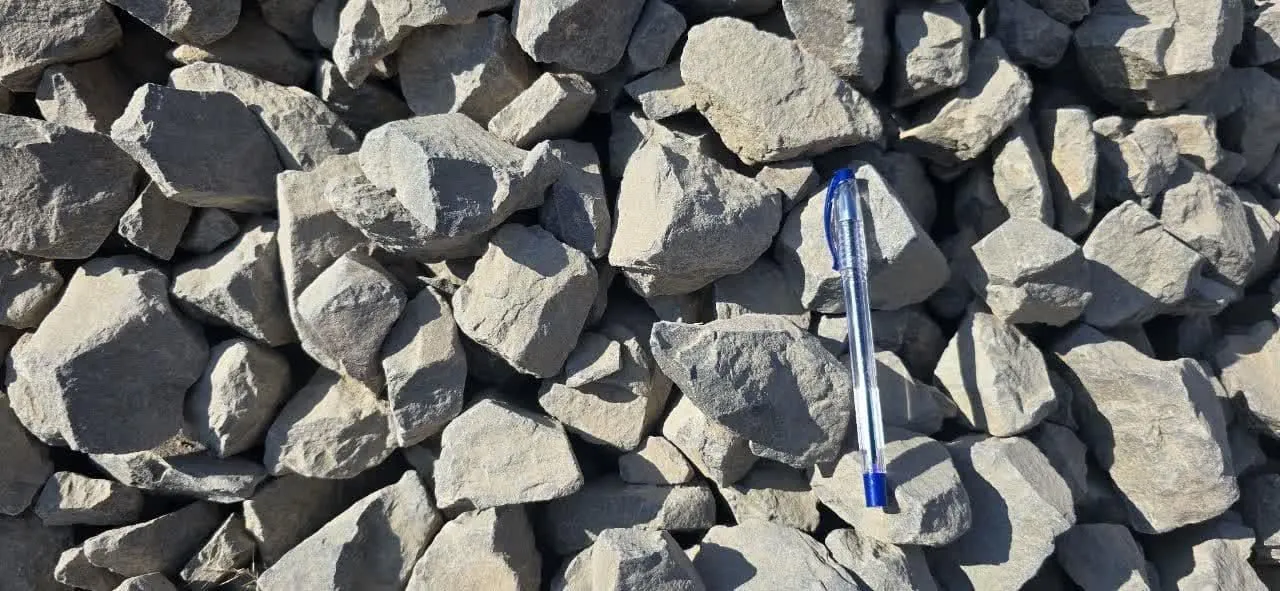
Elongated (needle) / flaky particlesBS 812Elongation 19 – 20%, flakiness 9 – 10%—
Flat & elongated particles (ratio 1:3)ISIRI 4791 / ASTM D47914.6 – 7.4%—
Loose unit weightASTM C291,683 kg/m³—
GradationAASHTO T27The grading curve lies within the specified envelope—
Rock core

Uniaxial compressive strength

Ten cylindrical cores (H/D ≈ 2.0) were tested: five saturated (Ø 6.5 cm, H ≈ 13 cm) and five dry (Ø 7.3 cm, H ≈ 14.6–14.8 cm). Each test took 4 to 5.5 minutes to failure. (ASTM D2938)

CoreSaturated (kg/cm²)Dry (kg/cm²)
11,0821,130
26601,299
39161,517
4896896
57291,192
Average8571,207

Dry — average

1,207 kg/cm²

Requirement in section 3-8: more than 1,200

Saturated — average

857 kg/cm²

Requirement in section 3-8: more than 800

Rock specific gravity

AASHTO T 275

SampleSpecific gravityBy dimensions
12.6762.650
22.790—
32.729—
Petrographic description

ASTM C294

Colour
Dark grey
Origin
Igneous
Texture
Aphanitic
Rock name
Basalt–andesite

The laboratory notes that the name is based on observation and field experience; exact naming requires a thin section and chemical analysis.

Ballast requirements

What railway ballast must satisfy

Resistance to abrasion and wear — Los Angeles

01
Standard
ASTM C535 / ASTM C131
Acceptance
≤ 30% over 1,000 revolutions

The wear and breakage of ballast is measured by the Los Angeles test over 1,000 revolutions. The procedure is given in ASTM C535 for particles larger than 2.54 cm and ASTM C131 for particles smaller than 2.54 cm.
Soundness of the material — sulfate attack

02
Standard
ASTM C88
Acceptance
Weight loss < 5% (max 8%) over 5 cycles

Soundness reflects the stone's durability through dry and wet, cold and heat and other chemical agents that erode aggregate over time. It is checked by the sulfate-corrosion test: the loss in weight over 5 continuous dry–wet cycles in sodium (or magnesium) sulfate solution, per ASTM C88, should be below 5% and at most 8%.

Specific gravity and absorption

03
Standard
ASTM C127
Acceptance
Specific gravity ≥ 2.6 T/m³; absorption 1% (2% worst case)

Specific gravity and porosity are among the most important properties of ballast: the material must have a suitable density and be affected as little as possible by moisture. Per ASTM C127 the specific gravity of ballast is at least 2.6 T/m³ and its maximum water absorption is 1%, or 2% in the worst case.

Dry and saturated compressive strength

04
Standard
Uniaxial core test
Acceptance
> 1,200 kg/cm² dry, > 800 kg/cm² saturated

The stone must be strong enough to carry all concentrated stresses, so the uniaxial strength of a cylindrical core is examined. For a core 5 cm in diameter and 10 cm high, tested alternately dry and saturated, the minimum strength exceeds 1,200 and 800 kg/cm². The core is loaded at about 0.2–1 MPa per second and takes at least 30 seconds to reach failure.

Frost resistance

05
Standard
—
Acceptance
Durable through the seasons

Use of the line does not stop in any season or rainfall, so ballast must keep its quality and durability as the seasons change.

Waste material

06
Standard
—
Acceptance
Within the permitted limit

The amount of deleterious material in ballast must not exceed the permitted limit.

Results are taken from the laboratory reports reproduced in the Nangerd operating-licence extension plan (Winter 1403). A consignment certificate is issued on request once the test has been carried out on that consignment.

Ballast in the technical dossier →
Crushed andesite ballast