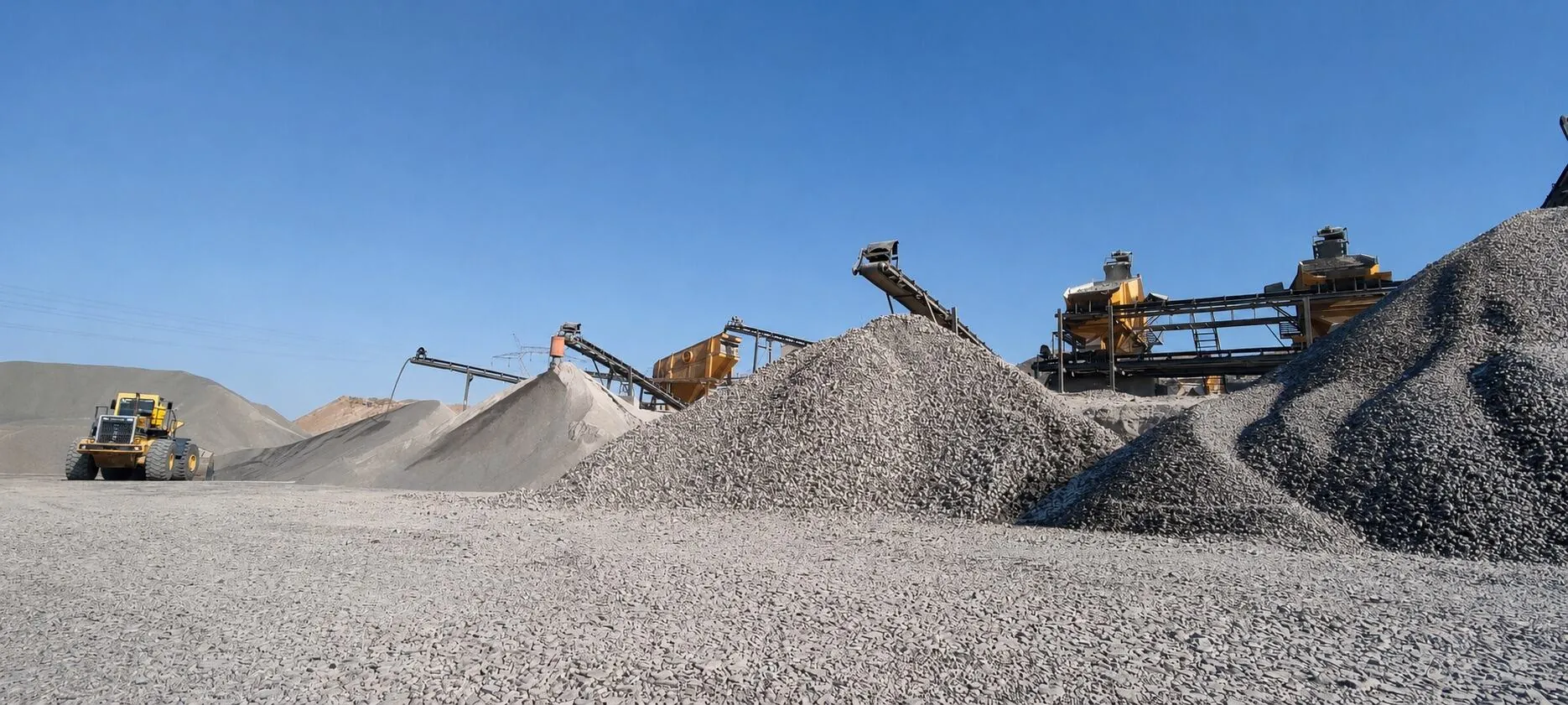
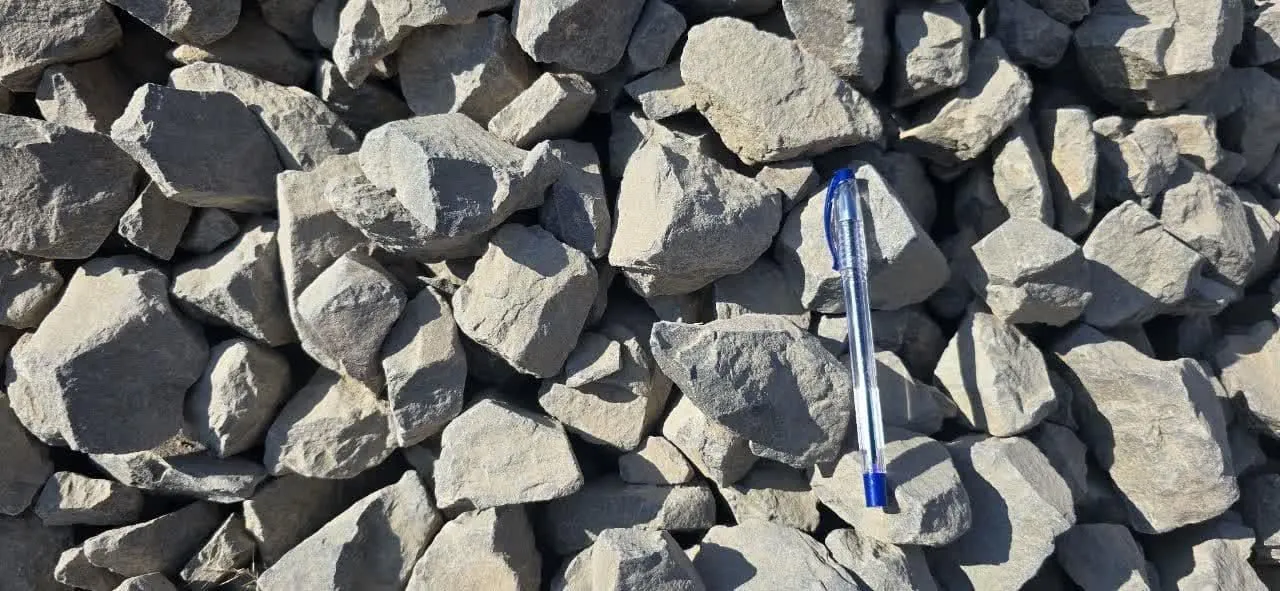
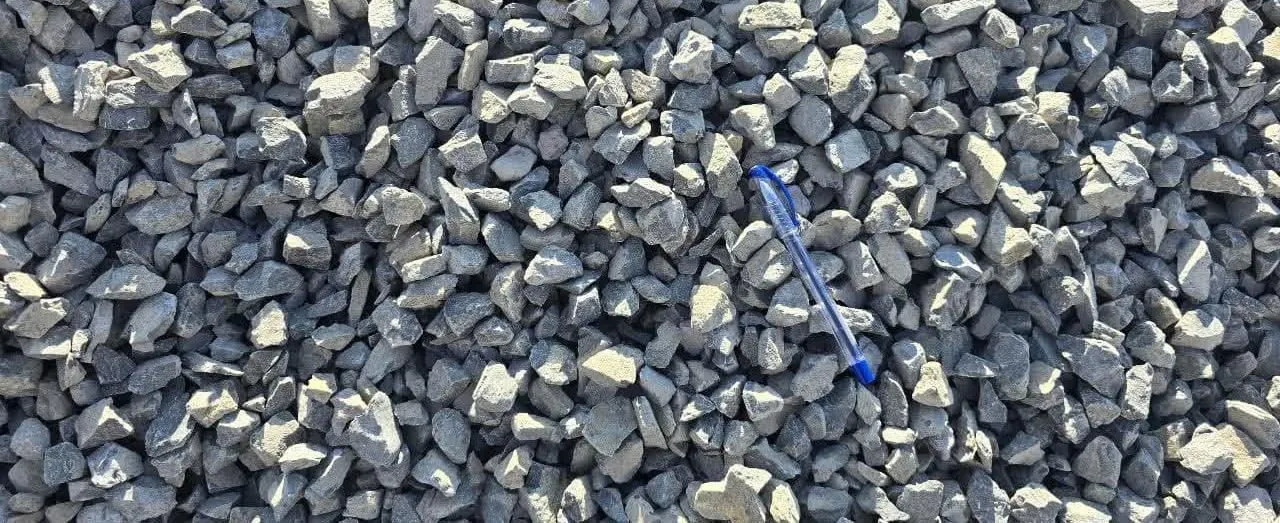
Ballast is a layer of crushed hard stone, with an average particle size of about 20 to 60 mm, on which the sleepers and rails rest. It is a designed, load-bearing layer of the track — not fill — and its quality governs how the track holds line and level. Nangerd produces ballast by crushing the andesite extracted at the mine; the material is approved by the Islamic Republic of Iran Railways and is regarded as the best ballast in the west of the country.
What Railway Ballast Does
Every quality requirement placed on ballast traces back to one of the jobs the layer has to do under traffic.
- Bears the vertical, horizontal and lateral forces on the sleepers and keeps the track in its designed position
- Provides part of the resilience and energy absorption of the track
- Spreads and transfers loads to the lower layers and distributes them over the formation
- Drains surface water away from the track
- Lets the rail be levelled and adjusted during laying and maintenance
- Damps shock, vibration and noise from passing trains
- Insulates the layer below against frost and prevents plant growth in the track
What Makes Good Ballast
Good ballast is hard, tough, angular and clean. It must resist abrasion and breakage under repeated wheel loads and tamping, stay sound through freeze–thaw and weathering, and keep its open, single-size grading so the layer drains and stays resilient. The properties checked are waste content, frost durability, abrasion resistance, soundness, specific gravity and absorption, and dry and saturated compressive strength.
Nangerd Ballast
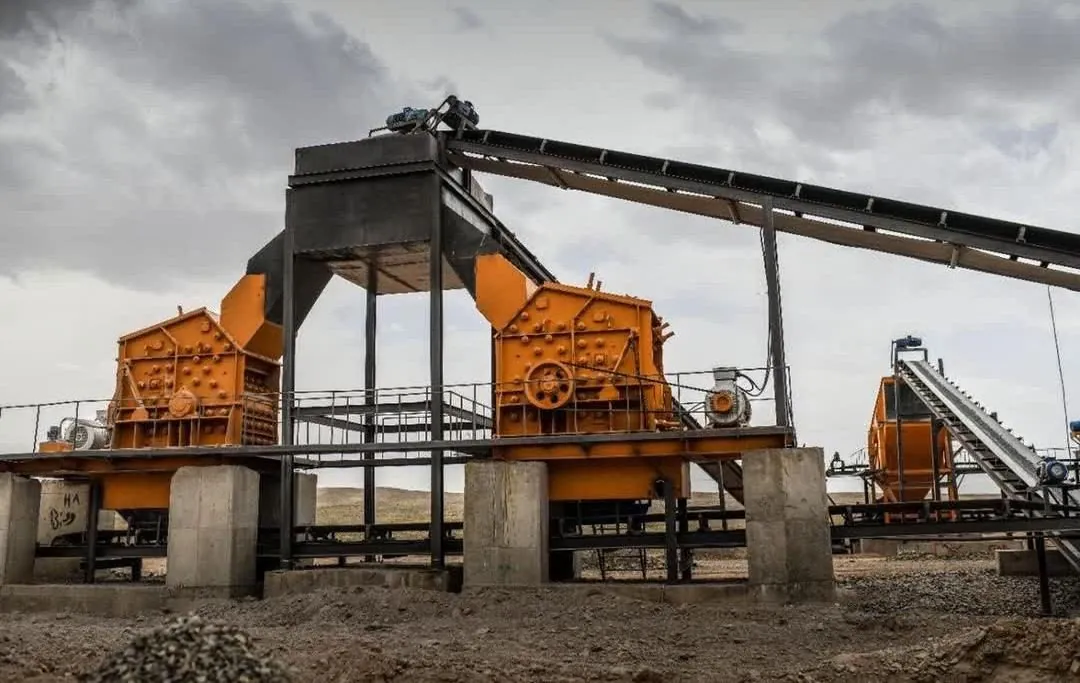
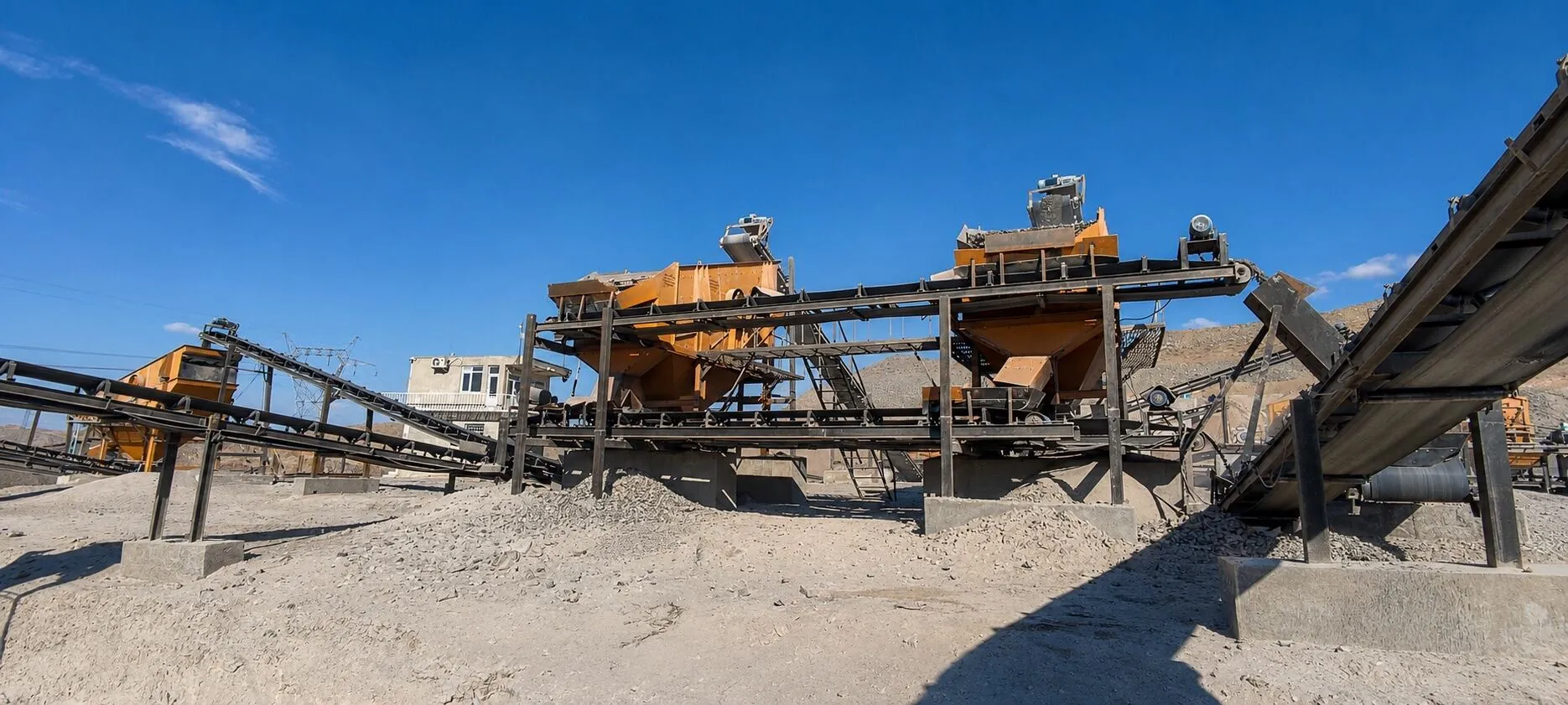
Nangerd produces ballast by crushing the extracted andesite on the mine's crusher lines. Given the compressive strength of the material, its water absorption, Los Angeles value and other properties, this stone is well suited for use as ballast. At present this material is approved by the national railway and is the best ballast in the west of the country. Because the mine lies about one kilometre from Nangerd station, ballast can be dispatched by rail as well as by road.
Tests & Quality Control
The quality and service life of ballast are defined by a set of tests. Below are the requirements and, for each, the result measured on Nangerd ballast by the Markazi Province Technical & Soil Mechanics Laboratory:
- Abrasion resistance — Los Angeles: wear and tear over 1,000 revolutions must not exceed 30%. The method is given in ASTM C535 for particles larger than 2.54 cm and ASTM C131 for particles smaller than 2.54 cm. Nangerd result: 11% (AASHTO T96).
- Soundness — sulfate attack: measured as weight loss over 5 successive dry–wet cycles in sodium (or magnesium) sulfate solution per ASTM C88; the loss should be below 5%, and at most 8%. Nangerd result: 0.3% (AASHTO T104).
- Specific gravity & absorption: per ASTM C127 the specific gravity is at least 2.6 T/m³, and the maximum water absorption is 1% (2% in the worst case). Nangerd result: specific gravity 2.725–2.837, absorption 0.9–1.2%.
- Particle shape: measured per BS 812 — elongation 19–20%, flakiness 9–10%; flat & elongated particles (1:3) 4.6–7.4%.
- Dry & saturated compressive strength: the uniaxial strength of a cylindrical core (5 cm diameter, 10 cm height) must exceed 1,200 kg/cm² dry and 800 kg/cm² saturated in alternating cycles; the core is loaded at about 0.2–1 MPa/s and takes at least 30 seconds to reach failure. Nangerd result: average 1,207 kg/cm² dry and 857 kg/cm² saturated (ASTM D2938).
- Waste content: the amount of deleterious material in the ballast must not exceed the permitted limit. Nangerd result: clay lumps 0.0%, material finer than 75 µm 0.1%.
Production Process
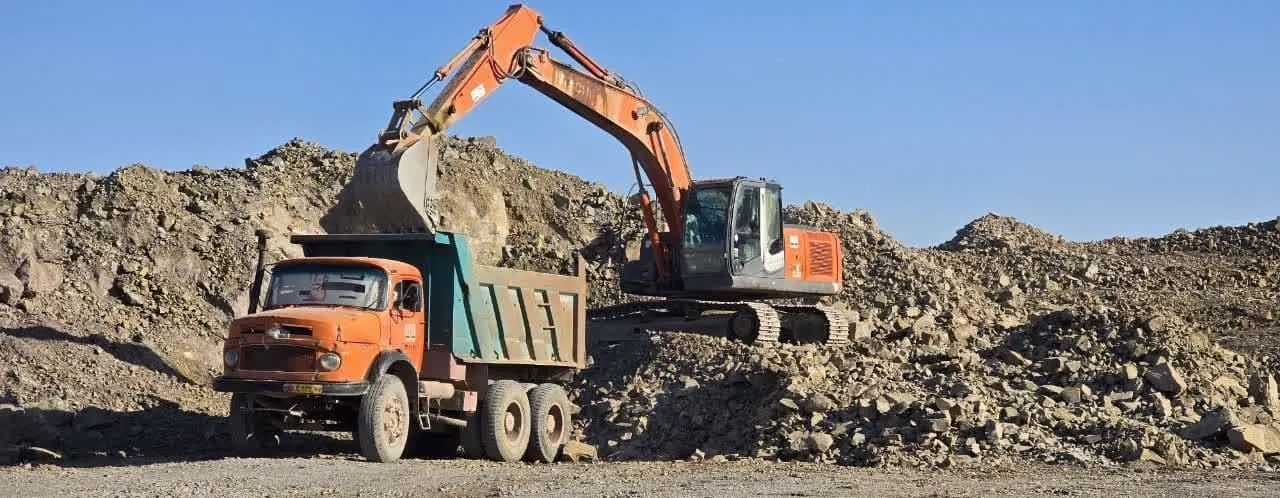
- Extraction from the working face
- Primary crushing (jaw)
- Secondary crushing (impact / kubit)
- Screening and grading
- Inspection and stockpiling
- Loading to truck or rail wagon